«The Estiennes, the great family of French philologists of the Renaissance, were of Albanian origin». (Faik Konica)
Lypim të dhëna mbi prejardhjen e Henri Estienne I (c.1460-*1520)..

Fred Schreiber, The Estiennes, New York, 1982: «The one and only certain fact which we may infer concerning the antecedents of Henri Estienne, before the appearance of his name in the 1502 colophon, is that he had established himself as a printer and bookseller by means of a practice typical of the Renaissance booktrade: that of marying the widow of a master-printer, who had died without heirs able to carry on the family business. In this case the master-printer was Johann Higman, Wolfgang Hopyl’s former partner.. From Higman and Hopyl, Henri Estienne inherited a close working relationship with the leader of the humanist movement in France, Jacques Lefèvre d'Etaples.. we have seen that Estienne's very first production was a work of Lefèvre. In fact, of Estienne's total output of about 130 editions, it is difficult to open any one without finding in it Lefèvre's name as author, editor, translator, or contributor.. Estienne's publications were consequently marked strongly by Lefèvre's own principal intellectual concerns, which included, besides the philosophy of Aristotle, biblical exegis, patristic literature, the tradition of medieval Christian mysticism, and the mathematical and physical sciences. Thus Estienne became a highly specialized publisher-printer to the University booktrade.., supplying students and scholars with the required scientific, philosophical, and liturgical texts».
'Robert Estienne, Royal Printer: An Historical Study of the Elder Stephanus', Elizabeth Armstrong, 1954: «In Rue Jean-de-Beauvais, one of the main channels through wich flowed the life of the Paris Univerisy, Henry Estienne, in the course of 1504-05, as a recently fledged university printer, installed his business. The antecedents of the business are esier to trace than those of the man. - Nothing is known of Henry Estienne before his sudden appearance as Hopyl's associate in 1502. - MS. fr. 18153 in the B.N. contains records of various Estienne families (mostly submitted in support of claims to nobilty in the seventeenth or eighteenth centuries); some of these give information about Estiennes, in which the favourite Christian names of the Paris Estenne family are to be found.. But
it is not until the end of the XVI century that one meets in this collection personages who can definitely be identified as members to this family.».
Ngjerë këtu asgjë nga burimet e mirënjohura, ndërsa gjetëm këto rreshta nga një libër francez i vjetit 1789, "Histoire du livre en France depuis les temps les plus reculés jusqu'en 1789", Edmond Werdet: «Au XV siècle, la famille des Estienne se divise en deux branches: la seigneurie de Lambèse reste dans la branche aînée, issue de Béranger; le chef de la branche cadette, Geoffroy, épouse Laure de Montelives, dont l'écusson de famille porte un Olivier. Geoffroy eut pour fils Raimond, qui fut son héritier, et
Henri, qu'il déshérita, en 1482, pour s'être adonné à l'imprimerie, qui venait d'être introduite en France en 1470. Quoique Henri I ait pris un soin tout particulier d'indiquer sa demeure sur les titres et à la fin de ses éditions, il n'est plus possible aujourd'hui de reconnaître la place même d'où jaillirent tant de science et de lumière, de même qu'à Venise personne ne saurait vous enseigner où fut la maison des Alde. Mais on sait positivement que l'imprimerie des Estienne était située au haut de la rue Saint-Jean-de-Beauvais, plus anciennement appelée rue du Clos-Bruneau, à une petite distance du collège de Beauvais, et vis-à-vis de l'école de droit canon, qui avait été fondée en 1384 par Gilbert et Philippe Ponce. Nous ne nous serions pas arrêté à cette particularité de la demeure des Estienne si tous les écrivains qui en ont fait mention ne l'avaient rendue à peu près méconnaissable. - Sur quelques livres on voit deux arbres et sous chacun un aigle; dans un cercle est placé le titre du livre, et au-dessous un écu vide. Quelquefois sur la banderolle tenue par les anges on lit cette devise: 'Plus olei quàm vini'; mais aux deux éditions de la Logique d'Aristote de 1503 et 1510, elle est remplacée, dit M.A.F. Didot, par ces mots qui semblent un présage de l'avenir réservé à la famille des Estienne: 'Fortuna opes au ferre, non animum potest'. - Henri I Estienne eut trois fils, qui embrassèrent la profession de leur père et s'y distinguèrent tous trois, bien qu'à des degrés fort différents. Le nom de sa femme est inconnu..».
Që këndej tuke shkruar '1482, Henri, Geoffroy Estienne' doli ky libër i rrallë i vjetit 1773, që mbartë të dhëna më të plota se libri 1789ës: 'Dictionnaire de la noblesse.. de France', Aubert de la Chenaye Desbois, 1773:

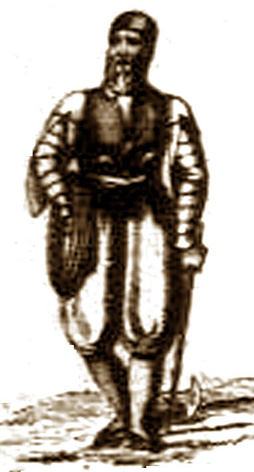
Estiennes - en proveçal d'Esteve, en latin Stephani, en Provence, est une des plus anciennes de la Province. Pierre d'Estienne dhe Guillame I d'Estienne, chevaliers Albanaise; ils portent un chapeau chargé de quelques plumes. Pra, ky libër i rrallë na kallëzon se emri i vërtet i Henri I Estienne ishte Guillame II d'Estienne; burimi i parë thotë se trashëgimia e Henri I Estienne i kaloj Raimondid, kushëririt të tij, më 1482; burimi i dytë thotë se trashgimia e Guillame II Estienne i kaloj Raimondid, kushëri të tij, më 6 Qërshor 1482. - Te rreshtat e fundit kallëzohet prejardhja arbërore e Guillame I d'Estienne, djali i vëllat të Pierre I d'Estienne, stërgjyshi i Guillame II/Henri I d'Estienne, themeluesi i shtypshkronjës Estienne më 1504 dhe i pari i një familje dijetaresh të mirënjohur aso kohe. Në se s'do e shkruante atë fjalì më sipër Faik Konica, patjetër s'do e kishim gjetë këtë të rrallë gjë mbi stërgjyshin shqiptar të Henricus Stephanus. @ArbëriaOnline.
_____________
The Estiennes

Family of Parisian and Genevan printers of the 16th and 17th centuries, distinguished through five generations in scholarship as well as in their craft. The first of the line was Henri Estienne, d. 1520, who was by 1502 established as a printer in Paris. Before his death more than 100 books, some of them of great typographic beauty, had issued from his press. His foreman, Simon de Colines, succeeded him and married his widow. Some years later, probably in 1526, Henri's son, Robert Estienne, b. 1498 or 1503, d. 1559, took over his father's shop, and Colines then founded a new establishment. Robert, a capable scholar, devoted himself to printing only scholarly works, many of which he himself edited. He put out editions of classical authors, dictionaries and lexicons, and, more especially, critical editions of the Bible. He enjoyed the favor of Francis I and became king's printer for Latin, Hebrew, and Greek. The printer's mark used by him, the Olive Tree, was apparently designed by Geofroy Tory, who is said to have been a proofreader for the elder Estienne; some of the Estienne types were designed by Claude Garamond . Robert Estienne, a thorough humanist, upheld the cause of the Reformation. Long-continued attacks upon him by the faculty of the Univ. of Paris and by political opponents of the king caused him to move to Geneva in 1550. He set up a press there and continued to print books until his death. His own Latin dictionary, Thesaurus linguae Latinae (1531), probably compiled with the aid of other scholars, is a monumental work. His grammatical treatises on French are also of great importance. One of Robert's brothers, François Estienne, d. 1553, was of minor importance as a bookseller, but another brother, Charles Estienne, c.1504-1564, succeeded Robert in the management of the Paris establishment in 1551. Educated in medicine and skilled in classical learning, Charles wrote many works on medicine, agriculture, and other subjects. A number of his books were printed by his brother, Robert, and by his stepfather, Colines. Among his best-known works are an encyclopedia, one of the earliest appearing in France, a treatise on dissection, and Praedium rusticum, which appeared later in English editions. The second Henri Estienne, 1531?-1598, the greatest scholar of the family, was one of Robert's sons. He inherited his father's press on the express condition that it should not be moved from Geneva. He was a well-trained scholar and devoted years to searching for manuscripts. Although humanism was far advanced, he, nevertheless, discovered numerous works of classical authors of which he issued first editions. His editions of Greek and Latin works are remarkable for their accuracy and textual criticism. The greatest monument to his scholarship is, perhaps, his Thesaurus Graecae linguae (1572). Henri II also championed the use of the French language and wrote valuable treatises on the French tongue and on French grammar; the most important is La Precellence du langage françois (1579), in spite of its gross errors in philology. His satirical Apologie pour Herodote (1566) brought him trouble with the Consistory of Geneva, and after the publication of Deux Dialogues du nouveau langage françois italianizé (1578) he went to France to escape censure in Geneva. He was imprisoned for a short time on his return and afterward became a wandering scholar. The books he printed did not equal those of his father in typographic beauty. He marks, however, the highest point of the family's career, although the Estiennes continued prominent as printers until late in the 17th century.




 Leonico Tomeo, Niccolò. Dee annoverarsi tra' primi, che, odiando il barbaro metodo di valersi delle antiche versioni del filosofo Aristotele, e di seguire i delirii e le follie degli arabi commentatori, prese a esaminare studiosamente le opere nel loro original greco, ed a purgarle dai gravissimi errori ond'erano imbrattate. Era egli nato a Venezia nel 1456 ed era oriondo dall'Albania, ove suo padre era nato. Studiò in Firenze la lingua greca alla scuola di Demetrio Calcondila,
