"Moreover, you scorned our people, and compared the Albanese to sheep, and according to your custom think of us with insults. Nor have you shown yourself to have any knowledge of my race. Our elders were Epirotes, where this Pirro came from, whose force could scarcely support the Romans. This Pirro, who Taranto and many other places of Italy held back with armies. I do not have to speak for the Epiroti. They are very much stronger men than your Tarantini, a species of wet men who are born only to fish. If you want to say that Albania is part of Macedonia I would concede that a lot more of our ancestors were nobles who went as far as India under Alexander the Great and defeated all those peoples with incredible difficulty. From those men come these who you called sheep. But the nature of things is not changed. Why do your men run away in the faces of sheep?"
Letter from Skanderbeg to the Prince of Taranto ▬ Skanderbeg, October 31 1460

EPIRI - PERKATESIA E TIJ SHQIPTARE

Këtu mund të flisni mbi historinë tonë duke sjellë fakte historike për ndriçimin e asaj pjese të historisë mbi të cilen ka rënë harresa e kohës dhe e njerëzve.
Post Reply
User avatar
Zeus10
Grand Fighter Member
Posts: 4227
Joined: Thu Jun 04, 2009 6:46 pm
Gender: Male
Location: CANADA
Contact:

Re: EPIRI - PERKATESIA E TIJ SHQIPTARE

#106

Post by Zeus10 »

Mallakastrioti wrote:O derman...po ketu ku thote Mnioi...mo jane gje Maniotet?...mo thote gje qe jane Ilire maniotet?....hahahahaha...me vjen te qesh me harten e gerxheve ne Wikipedia -lol-
Natyrisht qe eshte fjala per maniotet(si nuk ndryshoi ky emer per 2600 vjete :D ). Ja perkthimi ne anglisht:


24. MANIANS. And from Nestians is the Naron river: and the voyage into the Narona is not
narrow: and even a trireme voyages into it, and boats into the upper trading-town, being distant from the sea 80 stades. And these are Illyrian by nation, the Manians. And there is a lake inland from the trading-town, a great one, and the lake extends to Autariatai, an Illyric nation. And there is an island in the lake of 120 stades: and this island is very much well farmed. And from this lake the Naron river flows. And from the Naron up to the Arion river is a day’s voyage: and from the Arion river [up to the Rhizous river] a voyage of a day’s half: and Kadmos’s and Harmonia’s stones are here, and a sanctuary [not] far from the Rhizous river. And from the Rhizous river to Bouthoë the voyage ** and the trading-town.
The only thing necessary for the triumph of evil is for good men to do nothing
User avatar
ALBPelasgian
Galactic Member
Galactic Member
Posts: 2113
Joined: Sun Jun 28, 2009 7:57 pm
Gender: Male
Location: Prishtinë (Prima Justiniana)
Contact:

Re: EPIRI - PERKATESIA E TIJ SHQIPTARE

#107

Post by ALBPelasgian »

In the first part ‘Epiri-The Cradle of the Albanian People’, we have argued in a summarized manner some of the important facts cited in the chronics of the old authors but also of those modern, that Epiri population has never been Greek; that it was with an Illyrian content that was part of a Pelasgian complex. The main purpose of this study in continuance is to make known the continuity of ethnicity Illyro-Albanians in Epir from middle-ages all the way to our days.

On the Humanitarian Albanian books (Barleti, Frengu, Bardhi, etc) is mentioned at the same time the concept of ‘Albania’ ‘Epir’ and ‘Macedonia’ to mark the same place; the place of Albanians that according to the writings of the renowned British ethnograph H. Brailsford: “It is comparatively easy to say what Albania proper is. It is the mountainous home of an unconquered race which faces the Adriatic from the Gulf of Arta in the south to Montenegro in the north. It includes the greater part of Epirus with the town of Janina…”(1)

The frequent utilization and confound of these three terms to mark the same place it gives sufficient support for the establishment of continuance that the historical homogeneity of of these three ethno-geographic concepts. “These co-existence is a consequent not only for the historical reason of the character of the state and administrative, or vicinity, but it has to be said, and for the reason of the kinsfolk” (2), says historian Gazmend Shpuza.

It is not necessary to bring here the whole documentation of the Scanderbeg epoch to affirm the above mentioned, but what is more important is that Albanians in middle-ages have been identified off and on as Arber and Epirotes. “The general ancient name of the Albanians was Epirotes. Epiras has produced its share of celebrities among them Pyrrhus the son of Achilles himself a neighbouring Thessalian Olympia the mother of Alexander the Great George Castriot better known as Scanderbeg…”(3) writes Sutherland Menzies.

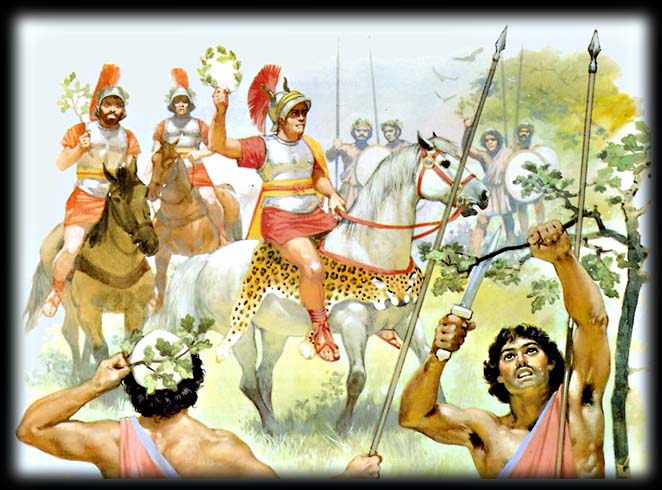
Precisely, Albanians have stored in their collective memories the historical consciousness of glorious times of Alexander the Great and Pirro of Epirus (albanian heroes) better than anyone else. ‘In the collective memory of the Albanians, Alexander the Great, also called Leka I Madh (Great Leka) and Pirro are even today folk well-known heroes, that have been noted for their bravery‘ (4).

Image

A picture showing the unforgettable king of Epir Pyrrhus of Epir (319-272 BC), and around him commanders, solders and people. Notice the white cap of this men and its similiarities with Traditional Albanian Cap.

The most important biographer of Scanderbeg Marin Barleti, with a origin from Shkodra, in the title of his book that came out in 1508-1510 called Scanderbeg “Epirotarum princeps”, meanwhile the second edition of this book translated in German by Johannes Pinicianus was titled “Herzog zu Epiro und Albanien” (Prince of Epirus and Albania) connecting it in a way with the ancient past with that of today. Let’s stop at the ethnic structure of Epir on the middle-ages period; how does it consists in Epir the ethnographic structure in the historical context?
Based on judgment of a Byzantine writer of 14th century, we learn that Epir even in middle-ages was inhabited by Illyrian race: “All that place (Epiri) in the ancient time were inhabited by the kins of…Thesprotians, Molosians, Chaonians that spread all the way to the Keraunia mountainous. Even now, that place is inhabited with villages gathered and spread by Albanians, Illyrians race” (5).
Every documentation for the historical period in report evokes strongly the immovable presence autochthon of Albanians in this vast region. Even the geographic description of a big number of geographers and different travelers are in the same idea that Epir is framed within Albanian integral, not only in the geographic concept, but of that ethnic, linguistic, cultural, etc. The New York Magazine, ‘The Eclectic Magazine of foreign Literature, science and art‘ writes: “As regards Epirus, there was another reason, perhaps, that nearly the whole of its population is now Albanian”(6).

Meanwhile, the famous British poet and traveler Lord Byron in the letter that he writes to Henry Drury on May 3, 1810 writes: “I first landed in Albania, the ancient Epirus”(7).

Another traveler, Viscountess Strangford in ‘The Eastern shores of the Adriatic in 1863’ writes: ‘We started on June 1, intending to make Ioaninna, the capital of Southern Albania, our farthest point”(8).

Another historian Edison L. Clark says: “Albanians, Arnauts as the turks calls them, or Shqiptars, live in the territory of ancient Epirus and in the territory of Illyrians in East Macedonia. From Montenegro(North) till the Ambracian Golf (South). …Ancient Epirots are different from Ancient Greeks, like Albanians from todays Greeks. Epirots and Illyrians where neighbor tribes , but of the same blood, which spoke different dialects of the same language”(9).

Beside this are a big number of proves that the realm of the Albanian language has comprise all Epirus: “The language of the Albanians, the Arnauts, or as they call themselves, the Shkipetars, is divided into two principal dialects, the Northern or Geghian, spoken in the ancient Illyria, and the southern or Toskian, in Epirus”(10) writes Friedrich Max Müller.

Epir in centuries has been one of the regions with most sensational historical events where there has been always shown always to have been Albanian families living and also rule. Is known historically that after 1375 in these regions lied the principality of Gjin Bue Shpata. After year 1385 its ruler was Gjin Zenebishi. In this historical trail, is very important tu underline also the time of Pashalluk and the most vigorously Albanian ruler Ali Pashe Tepelena (1741-1822) who ‘in the late eighteenth century, expelled the Turks and created an independent Epirote state’(11).

Meanwhile John Lee Comstock for the capital of Pashallek of Ali Pashe Tepelena says: “…His capital, loannina, or as others call it, Yanina, was situated in Lower Albania, the ancient Epirus’ (12).

William Guthrie calls Yanina as one of the biggest Albanian cities: ‘The two most considerable cities of Albania are Janina and Scutari. Janina is situated on the hank of a lake, almost in the center of Lower Albania. It was much improved during the sway of All Pasha, at which period its population amounted to 60,000” (13).

Except Yanina as Albanian city, other cities of Epir or South Albania were Albanian: “The other principal towns of Southern Albania are : Mezzovo, Ktntitxa, Premithi and Klittnin, noted for their fortifications ; Ârsyro- Castro or Ergir- Kastri, D f Ionia, Delbino or Dflrtno, Philatet or Philoti, Parnmithia, Souii, so celebrated for the long struggle of its inhabitants, the Suliotes against Ali Pasha ; Arta, Sahgnra ; Prereïti, at the entrance of the Gulf of Arta…”(14).

Over the time of the Ottoman Empire, all part of Epir or south Albania were a part of Yanina Vilayet. ‘Albanians formed the majority population in the vilayets of Kosovo, Ioanina and Shkoder. There was also a huge concentration in the Monastir Vilayet’(15).

Except this exist even a big number documentation over the demography of the Vilajet of Yanina. Very important to mentioned are the registering statistics of the year 1905-1906 in the book of the most known historian Nikolla Jorga, “Short history of Albania” 1919 where he underlines that in Epir were residing 227484 Albanian muslims, 213281 Albanian orthodox, 91991 greeks, and 4906 jews (16).

From these statistics comes out that the rapport of demography structure in Epirus consists this: 440.765 Albanians before 91.991 greeks. Except this in continuance you will have the chance to see a big number of maps that show Epir as part of Albania. In conclusion of all these evidences and facts that unfolded in this modest summary is the presence of the Albanians in Epirus that has never been absent. The general number of linguistic facts, ethnological, anthropological, geographical and graphic maps give a conclusive result the fact that Epirus has been and will be ‘The Cradle of Albanian People’.

(1) Henry N. Brailsford ‘Macedonia: Its races and Their Future’ 1906, pg. 88
(2)Gazmend Shpuza, ‘Nga Arbëreshët, perms epirotëve, te shqiptarët’ (From the Arberesh, through Epitoas to Albanians) http://www.aiitc.org/universi/nr3/studime2.html
(3) Sutherland Menzies ‘Turkey Old and New’, 1880, pg. 356
(4) Edith Durham ‘Some tribal origins, laws and customs of the Balkans’ London, 1928, pg.237
(5) History of Albanian People, Pristina 1999, pg.43
(6) The Eclectic Magazine of foreign Literature, science, and art. January to April, 1863, W.H.Bidwell, New York 1863, pg. 379
(7) Life, Letters, and Journals of Lord Byron by Baron George Noël Gordon Byron, 1844, pg.103
(8) Viscountess Strangford ‘The eastern shores of the Adriatic in 1863’ London 1864, pg. 2
(9) Edison L.Clark “Races of the European Turkey, their history, situation and prospectus”, New York, Brodway, 1878, fq.751
(10) Friedrich Max Müller ‘‘The Languages of the Seat of War in the East’ 1855, page 58
(11) James Minahan “Encyclopedia of the Stateless Nations: S-Z” 2002, pg. 579
(12) John Lee Comstock ‘History of the Greek revolution” 1828 pg. 86
(13) William Guthrie ‘A new geographical, historical, and commercial grammar’ 1843 pg. 463
(14) System of Universal Geography, Founded on the Works of Malte-Brun and Balbi, 1842, page 611
(15) Misha Glenny “The Balkans: Nationalism, War & the Great Powers, 1804-1999, published 2002, page 27
(16) History of Albanian People, Pristina 1999, pg. 219).

Attachment of maps:

Image
1. This map is showing the boundaries of Albania till Gulf of Corinth near the Peleopponesus Peninsula.
Image
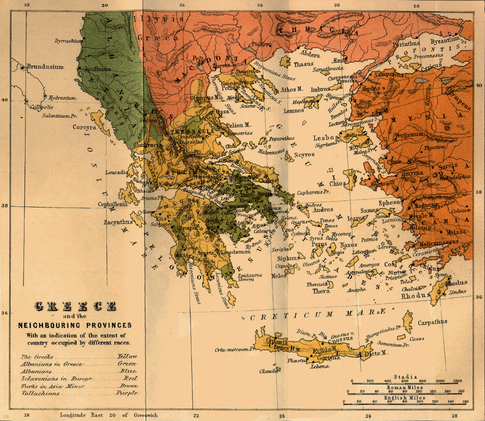
Map 2: This map showing that wholly Epir was inhabited in compact manner by Albanians. Meanwhile, the rest of Kingdom of Greece is inhabited by large ethnic Albanians marked with a green color. Source: “History of the Greek Revolution” Volume 1, by George Finlay, 1861.

Image
Map 3: This map shows as always the incontestable presence of the Albanians in these regions (southern Albania or Epir). ~Carte Ethnographique de la Turquie D’Europe~

Image
Map 4: This map shows that Albania bounded at south with Livadia (as a result the entirely region of Epir is Albanian land).

Image
Map 5: The four Vilayets of Albania during the Ottoman Empire.
Ne sot po hedhim faren me emrin Bashkim,
Qe neser te korrim frutin me emrin Bashkim!
User avatar
Mallakastrioti
Galactic Member
Galactic Member
Posts: 2936
Joined: Thu Jul 23, 2009 4:23 pm
Gender: Male
Location: Italy
Contact:

Re: EPIRI - PERKATESIA E TIJ SHQIPTARE

#108

Post by Mallakastrioti »

-haha- me vjen te qesh me greket qe kane nxjerre Procopius of Caesarea,si argumente te tyre te forte per perkatesine "greke" te Epirit....shihni cfare ngaterron Procopius:

Procopius wrote:"But I shall now wxplain how Italy is divided among the inhabitants of the land.The Adriatic Sea* sends out a kind of outlet far into the continent and thus forms the Ionian Gulf,but it does not,as in other places where the sea enteres the mainland,form an isthums at its end.For example,the so-called Crisean Gulf,ending at Lechaeum..."

*By the "Adriatic" is meant the part of the Mediterranean which lies between Africa on the South,Sicily and Italy on the west,and Greece and Epirus on the east;Procopius"Ionian Gulf" is herefore our Adriatic Sea (shenim i perkthyesit)

...dhe kjo tjetra:

Procopius wrote:"Now these people north of the Ionian Gulf were ruled by the Goths at the beginning of this war,but beyond the city of Ravenna on the left of the river Po(?) the country was inhabited by the Ligurians* "

*Procopius seems to have erred:Liguria,as well as Aemilia,was south of the Po.Cf.chap. XII.4,where Liguria is represented as extending Alps.

-lol- Prokopi e ka bere lemsh gjeografine e gerxhet e nxjerrin si "historiane" te besueshem

http://books.google.it/books?id=JQpeLjl ... es&f=false
Image
Socio
Star Member
Star Member
Posts: 693
Joined: Thu Sep 03, 2009 12:44 pm
Gender: Male

Re: EPIRI - PERKATESIA E TIJ SHQIPTARE nga Sherif Delvina 2006

#109

Post by Socio »

Image

Image

Image

Image
One cannot and must not try to erase the past merely because it does not fit the present
Socio
Star Member
Star Member
Posts: 693
Joined: Thu Sep 03, 2009 12:44 pm
Gender: Male

Re: EPIRI - PERKATESIA E TIJ SHQIPTARE

#110

Post by Socio »

Janina, the capital of Albania

Image
One cannot and must not try to erase the past merely because it does not fit the present
Socio
Star Member
Star Member
Posts: 693
Joined: Thu Sep 03, 2009 12:44 pm
Gender: Male

Re: EPIRI - PERKATESIA E TIJ SHQIPTARE

#111

Post by Socio »

Harta e gjirit te Artes nga Bellin, fundi i shek 19

Image

Lexoni (kah tregon shigjeta) se ku shtrihet gjiri i Artes !!
One cannot and must not try to erase the past merely because it does not fit the present
User avatar
Zeus10
Grand Fighter Member
Posts: 4227
Joined: Thu Jun 04, 2009 6:46 pm
Gender: Male
Location: CANADA
Contact:

Re: EPIRI - PERKATESIA E TIJ SHQIPTARE

#112

Post by Zeus10 »

Socio wrote:Harta e gjirit te Artes nga Bellin, fundi i shek 19

http://i788.photobucket.com/albums/yy16 ... shqipe.jpg

Lexoni (kah tregon shigjeta) se ku shtrihet gjiri i Artes !!
Me "fjale" te tjera:

Image
The only thing necessary for the triumph of evil is for good men to do nothing
User avatar
Zeus10
Grand Fighter Member
Posts: 4227
Joined: Thu Jun 04, 2009 6:46 pm
Gender: Male
Location: CANADA
Contact:

Re: EPIRI - PERKATESIA E TIJ SHQIPTARE

#113

Post by Zeus10 »

Shihni si eshte sot situata:

Image

Shihni si ishte jo me larg se dy shekuj me pare:

Image

Lexoni me vemendje: Greket e Janines flasin greqishten me te kulluar, sepse ju perkasin familjeve te pasura tregtare.

Mjafton ky rrefim per te kuptuar qe ata nuk jane vendas por jane te ngulurit e Lindjes ardhur nga qendra e Bizantit duke folur ne gjuhen e tij, qe natyrisht ishte me e pastra.
The only thing necessary for the triumph of evil is for good men to do nothing
User avatar
ALBPelasgian
Galactic Member
Galactic Member
Posts: 2113
Joined: Sun Jun 28, 2009 7:57 pm
Gender: Male
Location: Prishtinë (Prima Justiniana)
Contact:

Re: EPIRI - PERKATESIA E TIJ SHQIPTARE

#114

Post by ALBPelasgian »

Socio, të falemnderit për materialet e rralla që po i sjell! Këto materiale që ndrisin të vërtetën do të jenë
pishtari i pashuar qo do ta prijë historianët e rinjë shqiptarë por edhe atë të huaj që e duan të vërtetën
siç është, e jo të manipuluar nga filohelenia moderne.

Sigurisht, se ky forum po bëhet dita ditës 'nightmare' i të gjithë të fandaksurëve nga Junanistani.

Le të vazhdojmë përpara!

Ja edhe një kontribut i vockël në sajë të kërkimeve të mia në internet:

Image
Image
Image
Ne sot po hedhim faren me emrin Bashkim,
Qe neser te korrim frutin me emrin Bashkim!
User avatar
ALBPelasgian
Galactic Member
Galactic Member
Posts: 2113
Joined: Sun Jun 28, 2009 7:57 pm
Gender: Male
Location: Prishtinë (Prima Justiniana)
Contact:

Re: EPIRI - PERKATESIA E TIJ SHQIPTARE

#115

Post by ALBPelasgian »

Image
Image
Image
Ne sot po hedhim faren me emrin Bashkim,
Qe neser te korrim frutin me emrin Bashkim!
User avatar
ALBPelasgian
Galactic Member
Galactic Member
Posts: 2113
Joined: Sun Jun 28, 2009 7:57 pm
Gender: Male
Location: Prishtinë (Prima Justiniana)
Contact:

Re: EPIRI - PERKATESIA E TIJ SHQIPTARE

#116

Post by ALBPelasgian »

Image
Ne sot po hedhim faren me emrin Bashkim,
Qe neser te korrim frutin me emrin Bashkim!
User avatar
ALBPelasgian
Galactic Member
Galactic Member
Posts: 2113
Joined: Sun Jun 28, 2009 7:57 pm
Gender: Male
Location: Prishtinë (Prima Justiniana)
Contact:

Re: EPIRI - PERKATESIA E TIJ SHQIPTARE

#117

Post by ALBPelasgian »

Image
Ne sot po hedhim faren me emrin Bashkim,
Qe neser te korrim frutin me emrin Bashkim!
User avatar
ALBPelasgian
Galactic Member
Galactic Member
Posts: 2113
Joined: Sun Jun 28, 2009 7:57 pm
Gender: Male
Location: Prishtinë (Prima Justiniana)
Contact:

Re: EPIRI - PERKATESIA E TIJ SHQIPTARE

#118

Post by ALBPelasgian »

Image
Image
Image
Ne sot po hedhim faren me emrin Bashkim,
Qe neser te korrim frutin me emrin Bashkim!
User avatar
ALBPelasgian
Galactic Member
Galactic Member
Posts: 2113
Joined: Sun Jun 28, 2009 7:57 pm
Gender: Male
Location: Prishtinë (Prima Justiniana)
Contact:

Re: EPIRI - PERKATESIA E TIJ SHQIPTARE

#119

Post by ALBPelasgian »

Epiri - Pjesë e pandashme e Shqipërisë
Brockhaus Bilder-Conversations-Lexikon 1837-1841, Article : Albanien (excerpts)

Albania, called Arnaut by the Turks, a coastal landscape in European Turkey
of 700 square miles, covers the entire western slopes of the Pindos Mountains
toward the Adriatic and Ionian Sea, in the south bordered by the Gulf of Arta
and by Livadia
, in the north separated from Bosnia and
Serbia by the white Drino River.
Anskjaer, Geografisk-Statistisk Haandbog 1858-1863, Article : Albanien

Albanien, in Turkish Arnaut, province in European Turkey, at the Adriatic
and Ionian Sea, bordered by Dalmatia, Bosnia, Macedonia, Thessaly and Greece.
It contains the ancient Illyria and Epirus, area about 700 square miles,
Nordisk Familje-Bok 1876-1899, Article : Albanien (1876)
Albanien, in Albanian Skiperi, in Turkish Arnaut), landscape in European Turkey, contains a part of ancient Illyria with Epirus. It borders in the north on Bosnia, Montenegro and Dalmatia, in the east on Macedonia and Thessaly, in the south on Greece and Arta Bay, in the west on the Ionian and Adriatic Sea. Its area can be stimated as 800 square miles.
According to the new Turkish administrative division in Eyalets, he province is divided in the Eyalets of Jania (Janina) and Prisren (Prisrendi). The entire country, especially its southern part, or Epirus, is uncommonly wild, partially inaccessible mountain country, a land of mountain ridges incised by minor rivulets, containing the western extensions of the Pindos Mountains, which form the natural border with Thessaly and Macedonia. Minor plateaus are found here and there, for instance the one around Janina in southern Albania, or Epirus, with an average elevayion of 1200 to 1500 feet above the sea. The most prominent rivers are Arta, Vijuzza and Drino. Among the lakes those of Janina, Ohrid and Scutari deserve being mentioned. The climate is comparatively severe, especially in the northern tracts. Main occupations are livestock keeping and agriculture, the latter producing grain, and in the more fertile and sunnier valleys tobacco, livestock, wine and olives. The inhabitants, who are in many aspects a peculiar tribe, are called Albanians (in Turkish Arnauts, they call themselves Sqiptars, mountain inhabitants) are the descendants of the ancient Illyrians.' Their population is given at about 1.5 million. They are found outside of Albania in other areas of Turkey and Greece. They are especially strong, courageous and warlike, and oherwise known for their greed for gold, their faithlessness and their cruel wildness toward their enemies. The country's tribes live in nearly uninterrupted feud with each other. Public safety is poorly maintained. Every Albanian, so to say, was born to be a soldier, loves military service and gladly serves in the armies of he Orient. By religion the population is predominantly Muslim, especially in the country's south. Furthr there are about 200,000 to 300,000 Christians, which partially belong to the Greek, partially to the Roman Catholic Church. The Albanian language is a separate one, but little known, a connection with the Graeco-Italian branch of the Indo-European languages is probable, but not proven yet. The latest complete, but from scientific perspective poor work on grammar is Rossi's Regole grammaticale della lingua Albanese, Rome1866. Of the cities, Scutari and Janina stand out, located on the lakes by the same name, Prisren (Alban. Prisrendi), at the foot of the enormous Tsjar-Dag, and Durazzo, the ancient Epidamnus or Dyrrhachium, on the coast of the Adriatic Sea. The country's history containd in ancient timesKing Pyrrhus of Epirus, in the 1400s Prince Georg Kastriota, by the Turks called Skanderbeg, and in our century the fierce and forceful Ali Pasha of Janina. With the memory of the later has merged with that of the Suliots, an Epirot freedom-loving mountain people who stood out in the Greek struggle for independence.
Meyers Konversations-Lexikon 1885-1892, Article : Albanien
Albania, more an ethnographic than a geographic term, which refers to the land inhabited, or mainly inhabited by Albanians (see there), i.e. the Turkish Vilayets Scutari, Janina and parts of Kossovo and Salonica. Albanians live in he north up to the borders of Montenegro, up to Novibazar and Nisch, southward up to the 40th degree northern latitude (intermingled with Greeks along the coast up to 39 degrees 12 minutes), from the coast of the Adriatic Sea eastward until Bitolia, Üsküb and Leskowatz.
Ne sot po hedhim faren me emrin Bashkim,
Qe neser te korrim frutin me emrin Bashkim!
Socio
Star Member
Star Member
Posts: 693
Joined: Thu Sep 03, 2009 12:44 pm
Gender: Male

Re: EPIRI - PERKATESIA E TIJ SHQIPTARE

#120

Post by Socio »

Image

Image

Image

Image

Image

Image

Image

Image
One cannot and must not try to erase the past merely because it does not fit the present
Post Reply

Return to “Historia e Shqiperise”